
If you own an incorporated business in Canada, you may have heard the term "PSHP" in conversations about benefits and tax planning. A Private Health Services Plan (PHSP), which is also called a Health Spending Account (HSA), offers a tax-efficient way to cover medical expenses for you, your employees, and their families.
In this article, you'll learn what a PHSP is, how it works, who is eligible, and how it compares to traditional health insurance for Canadian businesses.
Key Takeaways: Understanding PHSPs in Canada for Small Businesses
- A PHSP is a CRA-recognized health benefit plan that reimburses eligible medical expenses tax-free for employees and their dependants.
- Incorporated businesses with employees or owner-employees who receive T4 income are eligible for a PHSP.
- Health Spending Accounts (HSAs) are a common type of PHSP, allowing employees to submit eligible medical expenses for reimbursement.
- PHSPs offer greater flexibility and cost control than traditional health insurance because employers only pay for the medical expenses that are claimed, and the benefit is 100% tax-deductible to the business and tax-free to employees.
- PHSPs can work alongside traditional insurance to fill gaps in coverage and reimburse co-pays or excluded services.
What is a PHSP in Canada?
A Private Health Services Plan (PHSP) is a type of health benefit plan recognized by the Canada Revenue Agency (CRA) that allows employers to reimburse employees for eligible medical expenses, tax-free. For the business, contributions to a PHSP are 100% tax-deductible.
A PHSP offers business owners flexibility and cost control that traditional group insurance plans often cannot match.
CRA Requirements for a PHSP
A plan must meet specific requirements from the CRA in order to be considered a PHSP.
All expenses covered by the plan must either be medical expenses, connected expenses, or a combination of medical expenses and connected expenses. A connected expense is an expense that is incurred in connection with a medical expense and within a reasonable time period following that medical expense. The plan must cover only your employees and their dependants.
See full details on the CRA's requirements for a PHSP here.
How Does a PHSP Work?
The employer opens a plan that lets them reimburse employees for medical expenses. A common form of this plan is a Health Spending Account (HSA).
When an employee incurs an eligible expense, they pay out of pocket and then submit a claim for reimbursement.
The plan provider verifies the claim and reimburses the employee using the employer's funds. The employee receives the money tax-free, while the business deducts the expense from its taxable income.
This reimbursement model differs from traditional insurance, where premiums are paid regardless of claims made. With a PHSP, you only pay for medical expenses that are actually incurred.
Who Is Eligible to Set Up a PHSP?
You are eligible for a PHSP if you:
- Own an incorporated business
- Pay medical bills
- Receive T4 income or have salaried employees
PHSP vs Traditional Health Insurance: What's the Difference?
Business owners often weigh PHSPs against traditional group health insurance.
The table below outlines the key differences between a PHSP and insurance:
|
Feature |
PHSP |
Traditional Insurance |
|
Premiums |
No premiums. Only pay for what is claimed |
Monthly premiums regardless of usage |
|
Tax Treatment |
Contributions are deductible, reimbursements are tax-free |
Premiums may be deductible, benefits are tax-free |
|
Coverage Flexibility |
Wide range of METC-eligible expenses |
Limited to policy terms and exclusions |
|
Deductibles/ Copays |
None |
Often required |
|
Predictability |
Costs vary with claims |
Fixed monthly cost |
Rather than choosing one over the other, many Canadian businesses find that PHSPs and insurance work well together. Insurance can be used for catastrophic coverage, and a PHSP can cover routine medical expenses, fill gaps, and reimburse co-pays and deductibles.
What Expenses Can Be Reimbursed Through a PHSP?
The list of eligible expenses through a PHSP is determined by the CRA. Below are some common eligible expenses:
- Prescription medications
- Dental care, including orthodontics and braces
- Vision care such as glasses, contacts, and laser eye surgery
- Physiotherapy, massage therapy, and chiropractic services
- Medical equipment and mobility aids
- Mental health services from registered practitioners
- Hospital expenses not covered by provincial health plans
- And more
With a PHSP, you can claim 100% of these eligible medical expenses, without premiums, copayments, or deductibles.
Benefits of a PHSP for an Incorporated One-Person Business
A PHSP is a valuable tax planning tool for incorporated consultants, contractors, and professional corporations.
The average Canadian family can easily spend $3,000 annually on medical expenses. Depending on your personal tax rate and province, a PHSP could save you anywhere from $500 to over $2,000.
Here's how the tax treatment works*:
For the business: contributions to a PHSP are fully deductible expenses. This reduces the corporation's taxable income.
For owner-employees: reimbursements received from a PHSP are not taxable income. This means you receive the full value of each dollar reimbursed, unlike salary or dividends which are subject to personal income tax.
.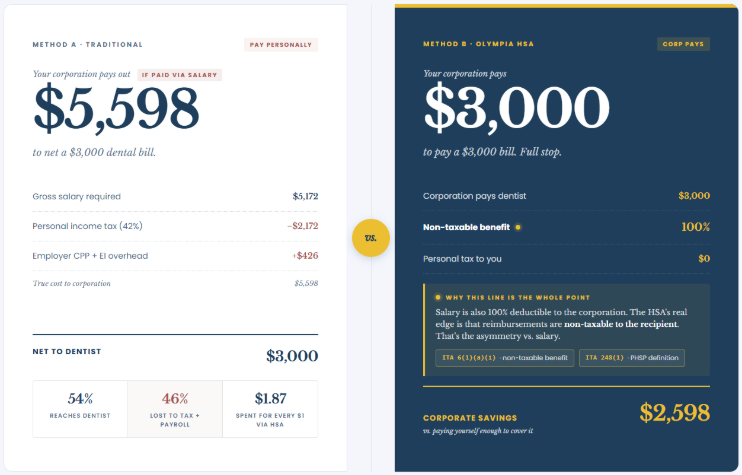
* Marginal rate varies by province and income. Replace 42% with your effective rate; the ratio holds. A CPA can confirm the exact dollar figure for your bracket.
Benefits of a PHSP for a Business with Employees
Using a PHSP for employee benefits provides flexibility for your team. Employees can choose how, when, and where to spend the money allocated to them through the plan. The employer can customize employee classifications and spending limits.
Here's how the tax treatment works:
For the business: contributions to a PHSP are fully deductible expenses. This reduces the corporation's taxable income.
For employees: reimbursements are 100% tax-free. Employees receive the full value of each dollar reimbursed, unlike salary or dividends which are subject to personal income tax.
Setting Up a PHSP: What to Consider
If you're considering a PHSP for your small business, here are a few questions to ask yourself:
- Is your business incorporated? A PHSP is not suitable for sole proprietors without arms-length employees.
- Do you have arm's length employees? Your PHSP will be structured differently depending on whether or not you have staff.
- What is your annual healthcare spending? This will help you calculate your annual savings with a PHSP.
- Do you want to complement existing insurance? A PHSP can fill gaps left by a spouse's group plan or individual insurance.
Choosing a reputable provider is essential. Look for one with experience in CRA-compliant plan administration, transparent pricing, and responsive customer support.
How Olympia Benefits Supports Business Owners
With over 25 years of experience in Health Spending Accounts (HSA), Olympia Benefits is a trusted leader in PHSP administration.
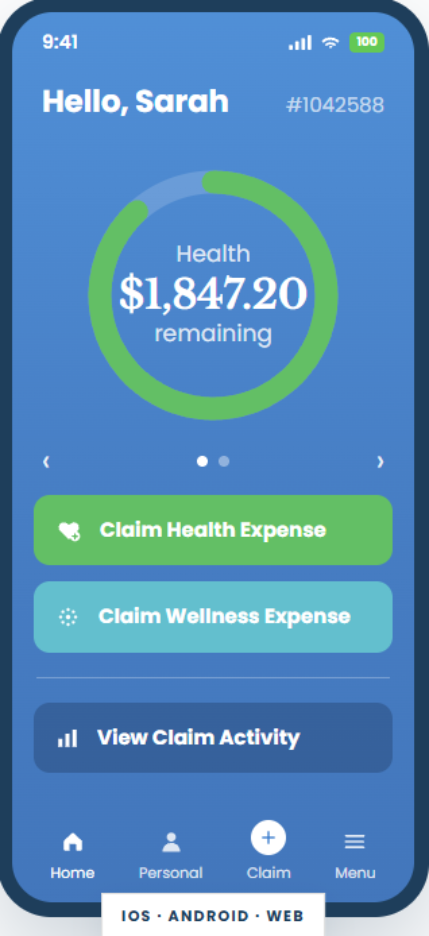
We’ve processed millions of claims for business owners and their employees. Claims can be submitted easily through our mobile app and are processed quickly, with reimbursements typically deposited into your personal bank account within 2 to 3 business days.
In Conclusion: Is a PHSP Right for Your Small Business?
A Private Health Services Plan (PHSP) offers Canadian business owners a flexible, tax-efficient way to manage healthcare expenses. By understanding the CRA requirements, eligibility rules, and how a PHSP compares to traditional insurance, you can make an informed decision about whether this approach fits your needs.
For many incorporated individuals and businesses, a PHSP delivers real value through tax savings, predictable costs, and freedom from the limitations of traditional insurance.
FAQs About PHSPs in Canada for Small Business Employers
What does PHSP stand for in Canada?
PHSP stands for Private Health Services Plan. It is a CRA-recognized arrangement that allows employers to reimburse employees for eligible medical expenses on a tax-free basis. Olympia Benefits offers Health Spending Accounts that qualify as PHSPs under CRA guidelines.
Is a Health Spending Account the same as a PHSP?
A Health Spending Account (HSA) is a common way to structure a PHSP. When properly administered, an HSA operates as a self-insured PHSP that meets CRA requirements.
Can I use a PHSP alongside my spouse's group insurance?
Yes, a PHSP can complement traditional health insurance. Use your spouse's insurance first, then submit any remaining out-of-pocket expenses (such as co-pays, deductibles, or excluded services) to your PHSP for reimbursement.
Have questions or want to see how a Health Spending Account would work for your business? Contact us at 1-888-668-8384 or info@olympiabenefits.com.
Disclaimer: This content is provided for general informational purposes only and does not constitute financial, tax, legal, insurance, or medical advice. Olympia Benefits Inc. makes no representations or warranties, express or implied, regarding the completeness, accuracy, reliability, and suitability of the information contained herein. While reasonable efforts are made to ensure the information is current, the applicable laws, regulations, guidelines, and administrative practices may change from time to time, and may also vary based on individual circumstances. Readers should conduct their own research prior to opening a Health Spending Account.